
 June 21, 2026
Most businesses have a marketing funnel, but very few have one that actually works end-to-end. The symptoms are familiar: traffic is coming in – from ads, from SEO, from social – but conversions aren’t following. Leads arrive but don’t become customers. Customers arrive but don’t return. The numbers look active on the surface, but revenue growth stays stubbornly flat.
More often than not, the diagnosis comes down to a disconnected funnel. Each piece was built in isolation, without a clear understanding of how it fits into the full journey a prospect takes from first encounter to loyal customer. The result is a funnel that leaks, perhaps even from multiple stages simultaneously, and because the leaks aren’t always visible, they go unaddressed for months or years.
Fixing a funnel starts with understanding what it’s actually supposed to do and then identifying precisely where it’s failing.
What a Modern Marketing Funnel Actually Looks Like
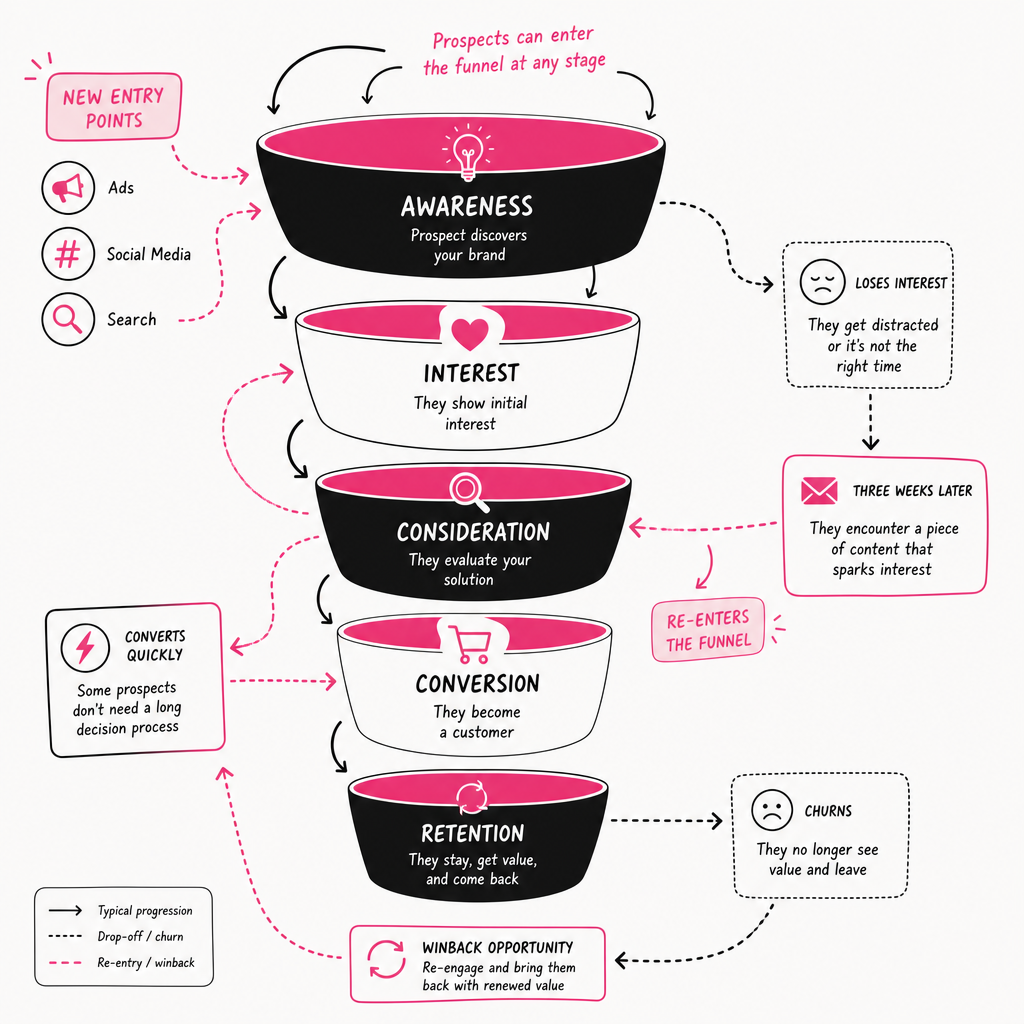
The classic funnel model – Awareness, Interest, Consideration, Conversion, Retention – is still a useful framework, but it’s important to understand that real customer journeys aren’t neatly linear. Prospects loop back. Someone discovers your brand, loses interest, encounters a piece of content three weeks later, re-enters the funnel at the consideration stage, and converts shortly after. Others convert quickly and then churn, re-entering as a winback opportunity. The funnel is better understood as a system with multiple entry and re-entry points, not a straight line from stranger to customer.
What this means practically is that each stage of the funnel requires its own strategy, its own messaging, and its own success metrics. A piece of content that works brilliantly at the awareness stage will fall flat when used as a conversion tool. A retargeting ad built for warm audiences will confuse a cold one. The businesses that get funnels right treat each stage with intentionality, and not simply as an afterthought.
The Most Common Mistake: Obsessing Over Top-of-Funnel
There’s a reason awareness gets most of the attention. Ads, social content, and SEO are visible, measurable, and exciting to run, and reach and impressions feel like tangible progress.
However, traffic does not directly translate to revenue. It is the beginning of a process, and if the middle and bottom of the funnel aren’t built to receive and convert that traffic, every dollar spent generating awareness is partially wasted. The leads arrive and disappear, and the business assumes it needs more leads when, in reality, it needs to do more with the ones it already has.
Middle and bottom funnel stages are where trust is built, objections are handled, decisions are made, and customers are retained, and are also most often neglected.
Breaking Down Each Stage of the Funnel
Stage 1: Awareness
The first question to ask is whether you’re targeting the right audience. Reach means nothing if it’s reaching people who were never going to buy. Precise targeting – by demographics, behaviors, intent signals, or lookalike audiences – is what separates traffic that converts from traffic that bounces.
The second question is whether your message is clear within five seconds. In a crowded digital environment, you have a brief window to communicate what you do, who it’s for, and why it matters. If your headline, ad copy, or opening hook requires effort to understand, most people won’t give you the time.
The third question is specificity. Broad messaging statements like “We help businesses grow” connect with no one. Specific messaging, on the other hand, like “We help e-commerce brands reduce cart abandonment by 30%,” speaks directly to a defined problem and a defined audience.
Stage 2: Interest
Once someone clicks through, the next job is to confirm that the promise you made at the awareness stage is real and relevant. The most common issue is message mismatch – the ad says one thing, and the landing page says something slightly different. That gap creates friction, and friction kills momentum. Every transition in the funnel should feel seamless, like a conversation continuing rather than starting over.
Landing pages and content at this stage need to answer one question above all others: “Why should I care?” If potential customers don’t understand your value immediately, they will lose interest. It’s also important for your content to build genuine trust through specificity, clarity, and demonstrated understanding of the audience’s problems.
Stage 3: Consideration
The consideration stage is where prospects are comparing options. They’re aware of you, they’re interested, and they’re deciding whether you’re the right choice. For this stage, case studies, testimonials, and real results are vital. They reduce perceived risk and give prospects the confidence to move forward. Differentiation is equally critical. If your messaging sounds identical to your competitors’, price becomes the only differentiator. A well-articulated point of difference, one that speaks to what makes your approach, methodology, or results genuinely distinct, gives prospects a reason to choose you over the alternatives.
Stage 4: Conversion
At the conversion stage, motivation is high, and this is exactly when unnecessary friction does the most damage. Prospects who are ready to act will abandon the process if it feels complicated, unclear, or untrustworthy.
Confusing calls to action are one of the most common conversion killers. When a page has three different CTAs pointing in different directions, prospects default to inaction. One clear, specific, benefit-led CTA consistently outperforms a page that asks visitors to do too many things at once.
The number of steps between intent and action also matters significantly. Every additional form field, page load, or decision point introduces an opportunity for confusion and conversion loss. Streamlining the path to action, whether that’s a form submission, a booking, or a purchase, directly improves conversion rates without changing anything about the offer itself.
Stage 5: Retention & Re-engagement
Acquiring a new customer costs significantly more than keeping an existing one, and customers who return spend more, refer more, and cost less to serve. Yet post-conversion nurturing is one of the most neglected areas in marketing strategy.
A structured email nurture sequence, a remarketing strategy for lapsed customers, and a genuine lifecycle approach can transform one-time buyers into repeat customers and brand advocates.
The absence of this thinking doesn’t just affect retention. It affects the entire funnel because a brand with high churn has to work exponentially harder on acquisition just to maintain its current revenue base.
How to diagnose funnel issues
Before you can fix a funnel, you need to know exactly where it’s leaking. That requires mapping every touchpoint a prospect encounters from their first interaction with your brand through to conversion and beyond. Using analytics, identify where drop-off is occurring. Where do people leave the website? Which emails aren’t being opened? At what point in the conversion process do prospects abandon? The data will show you where the funnel is failing and will help you understand where potential customers are losing clarity and motivation.
Funnel problems are almost always clarity problems. Something became confusing, unconvincing, or too effortful at a specific point in the journey. Find that point, and you’ve found your optimization opportunity.
A simple funnel optimization framework
When approaching funnel optimization, sequencing matters. Start with messaging. If your core value proposition isn’t clear and compelling, no amount of traffic, targeting, or UX improvement will compensate for it. Then fix targeting. Once the message is right, ensure it’s reaching the right audience – people with the problem you solve, the budget to address it, and the intent to act. Then fix the experience. Audit the landing pages, the conversion flow, and the content touchpoints. Remove friction, align messaging across stages, and make the path to action as clear and simple as possible. Finally, fix your follow-up systems. Build the email sequences, remarketing campaigns, and retention workflows that keep the relationship alive beyond the initial conversion. Each layer builds on the last, which is why it’s so important to do it in the right order.
Building A Well-Structured Funnel
Funnel optimization won’t be a one-time project. It’s an ongoing discipline, continuously identifying where the journey breaks down and making it better. Small, consistent gains at each stage of a well-structured funnel produce exponential improvements in overall marketing performance.
Want to optimize your marketing funnel? Contact us.