
 June 26, 2026
Ask most marketing teams how their efforts are performing, and the conversation turns almost immediately to leads: how many came in this month, what they cost, and how many converted. It’s an understandable habit because leads are countable, attributable, and easy to report up the chain. But that same countability has a cost: when lead generation becomes the only metric that matters, brand awareness quietly gets starved of budget, time, and attention.
Awareness and lead generation aren’t competing teams. They’re two halves of the same growth engine, and businesses that treat them as complementary tend to build the kind of momentum that compounds over time.
What Is Brand Awareness?
Brand awareness is the degree to which your target audience recognizes, remembers, and associates meaning with your brand, independent of whether they’re actively in a buying cycle. It’s built gradually, through repeated, consistent exposure rather than a single campaign or conversion event.
Recognition is the most basic layer: can someone identify your logo, name, or visual style when they see it, even without context? Familiarity goes a step further. Your audience not only recognizes you but has a general sense of what you do and who you serve, built up through repeated touchpoints across content, ads, and conversations. Trust is the layer that actually moves business outcomes – the belief, formed over time, that your brand will deliver on what it promises. All of these layers are the byproduct of consistent presence sustained over months and years, not weeks.
What Is Lead Generation?
Lead generation is the discipline of identifying and capturing people who have expressed some level of interest in what you offer, and moving them into a pipeline where a sales process can begin.
At its core, lead generation is about capturing demand that already exists – through search, ads, content offers, events, or referrals – before a prospect moves on to a competitor or loses interest entirely. From there, the job becomes turning prospects into opportunities: qualifying interest, nurturing it with relevant follow-up, and getting in front of the right decision-makers at the right time. The appeal of lead generation, especially to leadership, is its immediate pipeline impact. A new campaign can produce a measurable lift in leads within days or weeks, which makes it a natural focus for any team.
How Brand Awareness Improves Lead Generation
So if lead generation is faster and easier to measure, why bother with brand awareness at all?
Many marketing teams are pressured by easy-to-measure metrics. Cost per lead, conversion rate, and pipeline value are clean, defensible numbers. Brand awareness fits into those metrics; it compounds slowly, and there isn’t usually a tidy number to put in a slide that says “the brand is more trusted today than three months ago,” making it easier to deprioritize.
The irony is that underinvesting in brand awareness usually makes lead generation harder, not easier. A strong brand changes the economics of every lead generation effort that follows it.
Lower acquisition costs are the most direct effect, as audiences who already recognize your brand are cheaper to reach and more likely to engage. Better conversion rates follow naturally, since a familiar name earns more attention and the benefit of the doubt than an unknown one competing for the same click. Underneath both is increased trust: prospects who’ve encountered your brand multiple times before a sales conversation begins arrive with fewer doubts to resolve, which means shorter sales cycles – less time spent re-explaining who you are, and more time spent on the actual decision.
Finding the Right Balance
Balancing awareness and lead generation doesn’t necessarily just mean splitting the budget evenly. Marketing teams have to be deliberate about which problem they’re solving with which investment, and at what point in their business’s growth.
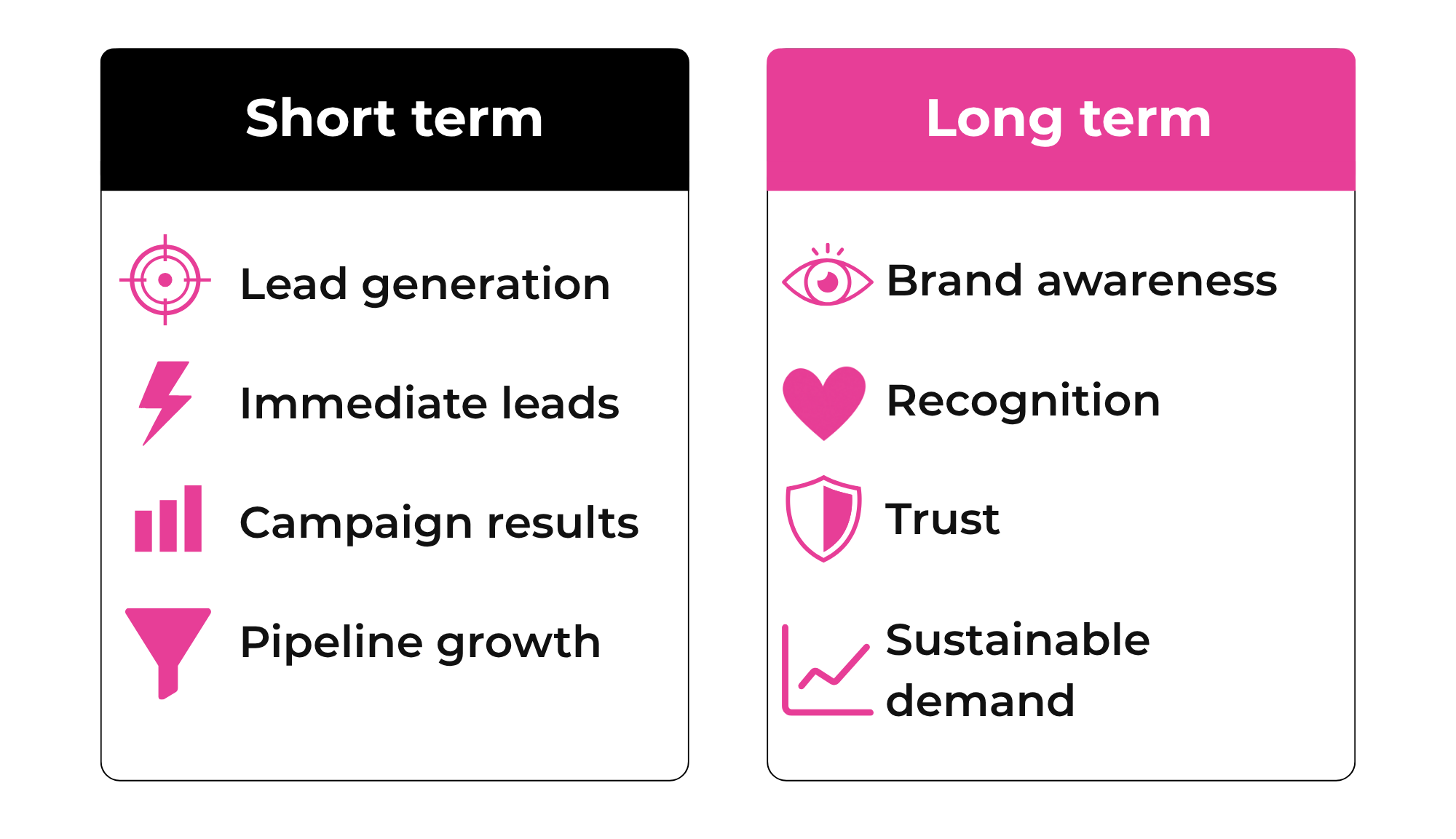
Awareness is a long-term investment: it compounds, but doesn’t pay off in the same reporting cycle it’s made in. Lead generation is a short-term investment: it produces faster, attributable results, but those results are harder to sustain without an underlying brand pulling new demand toward you. Both belong in a healthy marketing plan, simply on different timelines. The right mix also depends on matching tactics to business stage. An early-stage business with no name recognition often needs to lean harder into awareness just to be considered at all, while an established brand can shift more weight toward conversion. Neither weighting is permanent, and should shift as the business evolves.
Finally, measuring both effectively means resisting the urge to judge brand investment by lead generation metrics, and vice versa. Track awareness through reach, recall, and branded search volume. Track lead generation through cost per lead and pipeline velocity. Reporting on both, side by side, keeps either discipline from being judged by the wrong yardstick.
If your marketing is leaning too heavily on one side, get in touch – we can help you build a strategy that grows both your brand and your pipeline.